


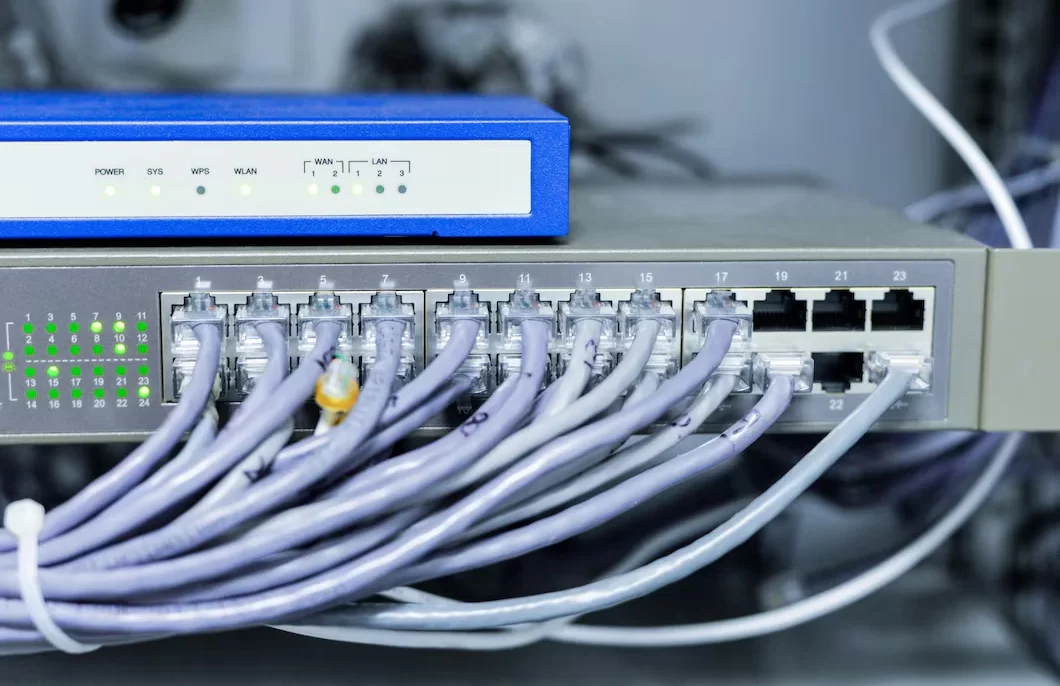
A WAN (Wide Area Network) is a network that connects computers and smaller networks over a large distance, such as across cities, countries or even continents. The internet is the biggest WAN in the world, and most companies use a WAN to link their head office, branches and data centres.
The full form of WAN is Wide Area Network. In this guide we explain how a WAN works, the main types of WAN connections, examples, advantages and drawbacks, and how it differs from a LAN and a MAN.
What Is a WAN?
A WAN spreads over a very wide area and joins many LANs and MANs into one large network. Unlike a LAN, it is rarely owned by one organisation alone. Most WAN links are rented from telecom companies or internet service providers, who run the cables, towers and satellites in between. To see where a WAN sits among other network types, read our guide on different types of computer networks.
How Does a WAN Work?
A WAN connects separate networks through routers. Each location has its own LAN, and a router at that site sends traffic out over a WAN link, such as a leased line, an MPLS network or the internet. The data hops through the provider’s network until it reaches the router at the other site, which passes it to the right device.
- Routers: forward data between sites and choose the best path. See our guide on networking devices.
- Transmission links: fibre cables, copper lines, microwave and satellite links. Read about transmission media.
- Service providers: telecom companies and ISPs that own and rent out the long-distance links.
- Security devices: firewalls and VPNs that protect data as it travels.
Types of WAN Connections
| Type | How it works | Best for |
|---|---|---|
| Leased line | A dedicated point-to-point link rented from a provider | Offices that need steady, private speed |
| MPLS | Provider network that forwards data using labels | Companies with many branches |
| Internet VPN | Encrypted tunnel over the public internet | Low-cost links and remote staff |
| Cellular (4G/5G) | Mobile network used as a WAN link | Backup links and small branches |
| Satellite | Link through a satellite, with higher delay | Remote or hard-to-reach places |
| SD-WAN | Software that manages several links from one dashboard | Modern multi-branch companies |
Examples of a WAN
- The internet: the largest WAN, connecting billions of devices.
- Bank networks: branches and ATMs connected to a central data centre across the country.
- Company networks: a head office in one city linked to branches in other cities.
- Airline and railway booking systems: counters in many cities connected to one system.
- Cloud services: offices connecting to data centres hosted far away.
Advantages of a WAN
- Wide coverage: connects people and offices in different cities and countries.
- Central data: all branches can use the same data and applications.
- Easy communication: email, video calls and shared tools work between distant locations.
- Scales easily: new branches can be added by adding another link.
Disadvantages of a WAN
- High cost: long-distance links and equipment cost more than a LAN.
- Slower speed: data travels farther, so delay is higher.
- Complex to manage: it needs skilled engineers and coordination with providers.
- Security risks: data travels over public or shared links, so encryption and firewalls are needed.
WAN vs LAN vs MAN
| LAN | MAN | WAN | |
|---|---|---|---|
| Area | Building or campus | City | Countries or world |
| Speed | Highest | Moderate | Lowest |
| Cost | Lowest | Moderate | Highest |
| Ownership | One organisation | Private or shared | Providers or many parties |
| Example | Home Wi-Fi | Cable TV network | The internet |
For a full comparison, read the difference between LAN, MAN and WAN.
WAN Kya Hai?
WAN ka full form Wide Area Network hai. Ye alag-alag shehron ya deshon ke networks ko ek saath jodta hai. Internet duniya ka sabse bada WAN hai. Company ke head office aur branches ko jodne ke liye bhi WAN use hota hai.
Conclusion
A WAN connects networks across long distances and makes it possible for businesses, banks and the internet to work across cities and countries. It costs more and is slower than a LAN, but without it there would be no connected world. To see how devices are arranged inside these networks, read our guide on network topology.
If you want a career in networking, our CCNA 200-301 course teaches LAN, WAN and routing from the basics. Not sure where to begin? Read what CCNA is or check the CCNA course fees in India.
Frequently Asked Questions (FAQs)
What is a WAN?
A WAN, or Wide Area Network, connects computers and smaller networks over a large distance, such as across cities, countries or continents.
What is the full form of WAN?
The full form of WAN is Wide Area Network.
What are examples of a WAN?
The internet, a bank’s network linking branches and ATMs, and a company network connecting offices in different cities are examples of a WAN.
How is a WAN different from a LAN?
A LAN covers a small area such as one building and is fast and cheap, while a WAN covers large distances and is slower and costlier because it depends on provider links.
Is the internet a WAN?
Yes. The internet is the largest WAN, made of many smaller networks connected across the world.
What is SD-WAN?
SD-WAN, or Software-Defined WAN, uses software to manage several WAN links, such as broadband, MPLS and 4G or 5G, from one central dashboard.

PM Networkingis an emerging leader in the ed-tech space, founded by Praphul Mishra in 2020 with a vision to democratize tech education. The journey of PM Networking began as a YouTube channel with the sole purpose of sharing valuable knowledge in the fields of Networking, Cyber Security, and Cloud Computing. What started as a humble effort to educate has rapidly evolved into a comprehensive online learning platform that caters to the growing demand for specialized IT skills. PM Networking stands out in the crowded ed-tech industry by providing affordable, world-class training tailored to the needs of aspiring IT professionals. The platform is dedicated to equipping learners with the skills and knowledge required to excel in the highly competitive tech industry. Whether it’s Networking fundamentals, advanced Cyber Security protocols, or mastering the complexities of Cloud Computing, PM Networking offers a range of courses designed to cater to different levels of expertise.
0 Comments