


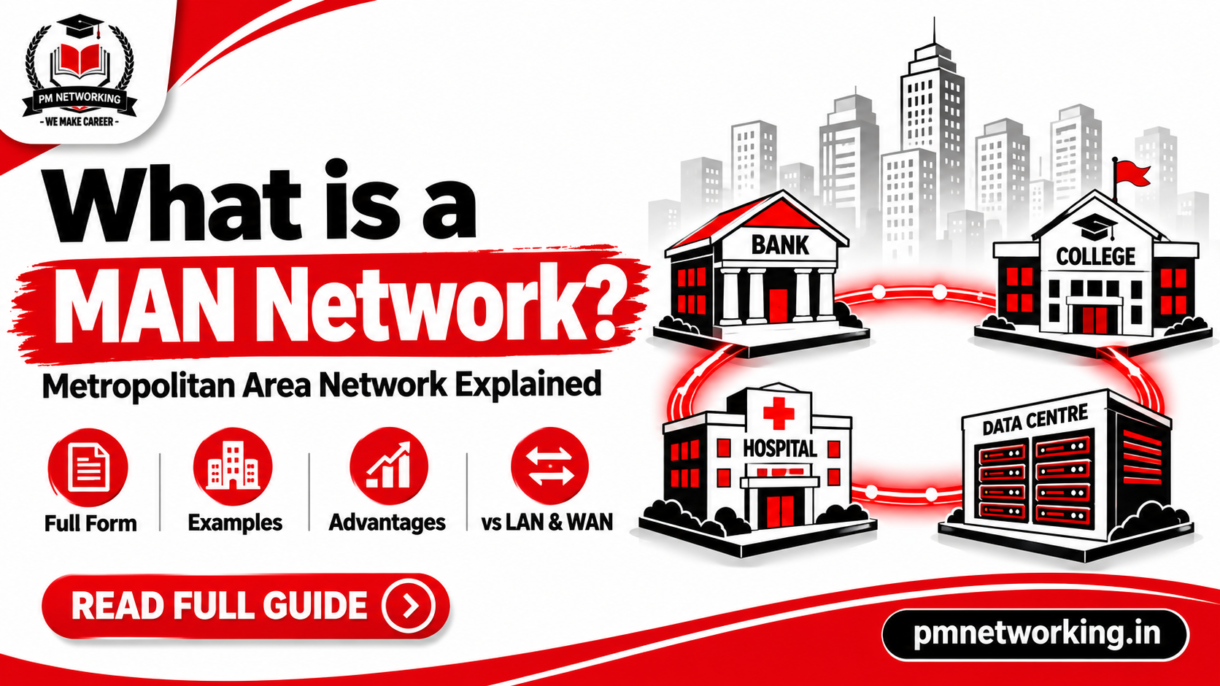
A MAN network is a computer network that connects offices, users and smaller networks across a city or a large metropolitan area. The full form of MAN is Metropolitan Area Network. It sits between a LAN (local area network) and a WAN (wide area network): bigger than a building or a campus, smaller than a country.
Think of a bank with branches in every part of Surat. If all of those branches share one private, high-speed network, that network is a MAN.
What Is a MAN Network?
A MAN (Metropolitan Area Network) covers a city or a large urban area, usually somewhere between 5 and 50 km. It links many smaller networks, such as the LANs of offices, colleges and hospitals, so they can share data, internet access and services at high speed.
A MAN can be owned by one organisation, like a bank or a city government, or by a service provider that rents the connection to many customers. If you want to see where it fits among all network types, read our guide on the different types of computer networks.
MAN Full Form in Computer Network
The full form of MAN in computer networks is Metropolitan Area Network. “Metropolitan” simply means a city and the area around it. So if an exam asks for the MAN full form in computer, the answer is Metropolitan Area Network.
MAN Network Kya Hai?
MAN ka full form Metropolitan Area Network hai. Simple bhasha mein, jab ek hi shehar ke alag-alag LANs ko high-speed fibre ya cable se jod diya jaata hai, to us bade network ko MAN kehte hain. Ye LAN se bada aur WAN se chhota hota hai. Computer network mein MAN ka pura naam Metropolitan Area Network hai.
How a MAN Network Works
Most MANs are built around a fibre optic backbone, often laid as a ring around the city. A router or switch at each location connects the local LAN to that backbone. Because a ring gives two paths, traffic can go the other way round if one cable is cut.
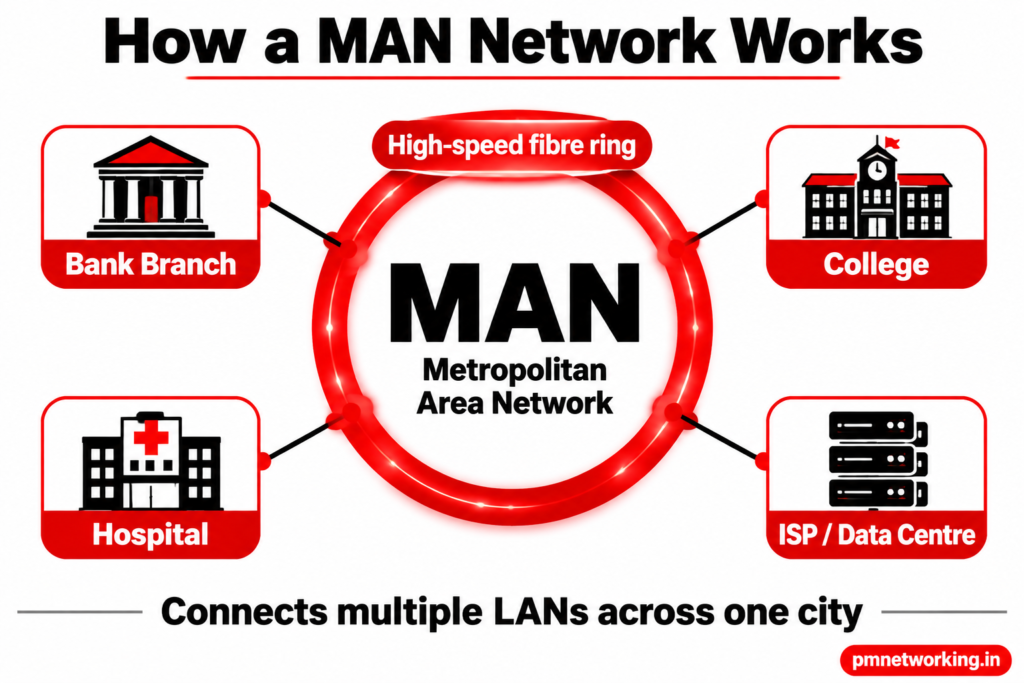
The usual building blocks are:
- Fibre optic cable is the most common transmission medium for a MAN because it carries a lot of data over long distances.
- Routers and switches at every site, the same networking devices you see in any office network, only built for heavier traffic.
- Technologies such as Metro Ethernet, SONET/SDH and MPLS to move traffic between sites.
Modern fibre-based MANs can run from hundreds of Mbps to 10 Gbps and beyond, while older copper and wireless links were much slower. Many MANs use a ring layout, but star and mesh designs are also common. Our guide on network topologies explains the differences.
MAN vs LAN vs WAN
| Feature | LAN | MAN | WAN |
|---|---|---|---|
| Full form | Local Area Network | Metropolitan Area Network | Wide Area Network |
| Coverage | One building or campus | A city or metro area, about 5 to 50 km | Countries or the whole world |
| Speed | Very high | High | Lower, depends on the link |
| Ownership | Usually private | Private or a service provider | Usually leased from providers |
| Cost to set up | Lowest | Moderate | Highest |
| Example | Office Wi-Fi | City-wide bank branch network | The internet |
Want a deeper comparison? See the difference between LAN, MAN and WAN.
Examples of a MAN Network
You already use MANs without noticing them. Some common examples:
- Cable TV networks. A cable operator links neighbourhoods across a city to one headend, so thousands of homes get TV and broadband from the same network.
- Bank branches and ATMs. Branches in different parts of a city connect to the bank’s central data centre, so your balance looks the same at every branch.
- Government offices. City departments share records and services through one private network instead of separate links.
- Universities and colleges. A college with campuses in different areas of a city can give students and staff one common network.
- Hospitals. Hospital groups share patient records and scan images between their sites.
- Internet service providers. An ISP runs a MAN to connect homes and offices in a city to its main network.
Advantages of a MAN Network
- Faster than a WAN. Over a city-sized area, fibre links give high speed with low delay.
- One network for the whole city. Offices in different areas share servers, databases and internet access.
- Central control. One team can monitor the network, take backups and apply security rules for every site.
- Reliable design. A ring layout gives traffic a second path if one cable fails.
- Often cheaper than separate links. One shared backbone usually costs less than leasing a line between every pair of sites.
- Handles heavy traffic. Video calls, CCTV feeds and large file transfers run without much trouble.
Disadvantages of a MAN Network
- Costly to set up. Laying fibre across a city takes money and permissions.
- Needs skilled engineers. Designing, monitoring and fixing a MAN is harder than running a LAN.
- Harder to secure. More sites and users mean more entry points that must be protected.
- A cable fault affects many sites. Repairs across a city can take time.
- Speed can drop. When many sites share the same backbone, heavy use slows everyone down.
- Slower than a LAN. A LAN inside one building is usually faster than a link across a city.
Conclusion
A MAN (Metropolitan Area Network) connects LANs across a city so offices, campuses and branches can work as one network. It is faster than a WAN over the same distance and covers more ground than a LAN, but it costs more to build and needs skilled people to run it.
If you want to learn how networks like these are designed, secured and troubleshot, the CCNA course at PM Networking covers LAN, WAN and routing from the basics. Not sure where to begin? Read what CCNA is or check the CCNA course fees.
Frequently Asked Questions
What is a MAN network?
A MAN network is a computer network that connects LANs and users across a city or a large metropolitan area, usually within about 5 to 50 km. Banks, colleges, hospitals, cable operators and ISPs commonly use one.
What is the full form of MAN in computer networks?
The full form of MAN in computer networks is Metropolitan Area Network.
MAN network kya hai?
MAN ka matlab Metropolitan Area Network hai. Ye ek shehar ke alag-alag LANs ko high-speed link se jodta hai. Ye LAN se bada aur WAN se chhota hota hai.
How is a MAN different from a LAN and a WAN?
A LAN covers one building or campus, a MAN covers a city, and a WAN covers countries or the whole world. LANs are usually the fastest and cheapest, while WANs are the slowest and most expensive.
What are examples of a MAN network?
Cable TV networks, bank branch networks, government offices in a city, university campuses in different areas, hospital groups and ISP networks are all examples of MANs.
What are the advantages of a MAN network?
A MAN gives high speed over a city, central management, a reliable ring design and shared resources across many sites. It is usually cheaper than leasing separate lines between every site.

PM Networkingis an emerging leader in the ed-tech space, founded by Praphul Mishra in 2020 with a vision to democratize tech education. The journey of PM Networking began as a YouTube channel with the sole purpose of sharing valuable knowledge in the fields of Networking, Cyber Security, and Cloud Computing. What started as a humble effort to educate has rapidly evolved into a comprehensive online learning platform that caters to the growing demand for specialized IT skills.PM Networking stands out in the crowded ed-tech industry by providing affordable, world-class training tailored to the needs of aspiring IT professionals. The platform is dedicated to equipping learners with the skills and knowledge required to excel in the highly competitive tech industry. Whether it’s Networking fundamentals, advanced Cyber Security protocols, or mastering the complexities of Cloud Computing, PM Networking offers a range of courses designed to cater to different levels of expertise.
0 Comments