







Ask any experienced network engineer how their career progressed, and you’ll usually hear the same three letters in order: CCNA, then CCNP, then — for the few who go all the way – CCIE. This isn’t a coincidence. Cisco built its certification program as a genuine career ladder, where each level builds directly on the last. This guide walks through what each level actually means, how long the path realistically takes, and how to decide how far you need to go.
The Cisco Certification Levels at a Glance
| Level | Certification | What It Proves | Typical Career Stage |
|---|---|---|---|
| Associate | CCNA | Broad foundational networking knowledge | Entry-level, Junior Network Engineer |
| Professional | CCNP | Deep, specialized expertise in one technology track | Mid-level, Senior Network Engineer |
| Expert | CCIE | Elite, hands-on mastery validated through a lab exam | Senior/Principal Engineer, Network Architect |
Cisco also has an Entry level (CCST) below CCNA and an Architect level (CCAr) above CCIE, but CCNA → CCNP → CCIE remains the core path most networking professionals follow.
Step 1: CCNA — Building the Foundation
CCNA (Cisco Certified Network Associate) is a single exam, 200-301, covering a broad mix of topics: network fundamentals, routing and switching, IP services, security fundamentals, and automation basics. There’s no formal prerequisite, which makes it the natural starting point for anyone entering networking.
- Typical timeline: 3-5 months of preparation for most beginners
- Exam format: Single 120-minute exam
- What it opens up: Roles like Network Administrator, Network Support Engineer, or Help Desk Technician with a networking focus
If you’re still deciding whether to budget for this step, our CCNA certification cost in India blog breaks down the exam fee and training costs in detail.
Step 2: CCNP – Going Deep Into a Specialization
Where CCNA tests breadth, CCNP (Cisco Certified Network Professional) tests depth in one specific technology area. You choose a track — Enterprise, Security, Data Center, Collaboration, Service Provider, and others — and that choice shapes your next few years of career focus.
To earn a CCNP, you need to pass two exams: a core exam for your chosen track (for example, ENCOR for Enterprise) and a concentration exam on a more specific topic within that track (for example, ENARSI for advanced routing and switching).
- Typical timeline: 4-8 months after CCNA, depending on how much hands-on experience you already have
- Exam format: Core exam plus one concentration exam, each separately scheduled
- What it opens up: Senior Network Engineer, Network Administrator, Infrastructure Engineer roles, and noticeably better salary bands than CCNA alone
Choosing the right CCNP track matters. If your interest is deep routing and switching, our CCNP ENCOR syllabus and exam tips blog is a useful next read once you’ve got CCNA locked in.
Step 3: CCIE — Reaching Expert Level
CCIE (Cisco Certified Internetwork Expert) is widely regarded as one of the hardest IT certifications to earn, and it’s structured very differently from CCNA or CCNP. It requires passing a written qualification exam, followed by an 8-hour hands-on lab exam where you configure and troubleshoot a complex network under time pressure, with no multiple-choice shortcuts.
- Typical timeline: Usually pursued after 2-4+ years of hands-on experience beyond CCNP
- Exam format: Written qualification exam, followed by a separate practical lab exam
- What it opens up: Principal Engineer, Network Architect, and other senior technical leadership roles
Not everyone needs to reach CCIE, and that’s a genuinely reasonable career decision, not a shortcut. Many engineers build long, well-paying careers at the CCNP level without ever attempting the CCIE lab.
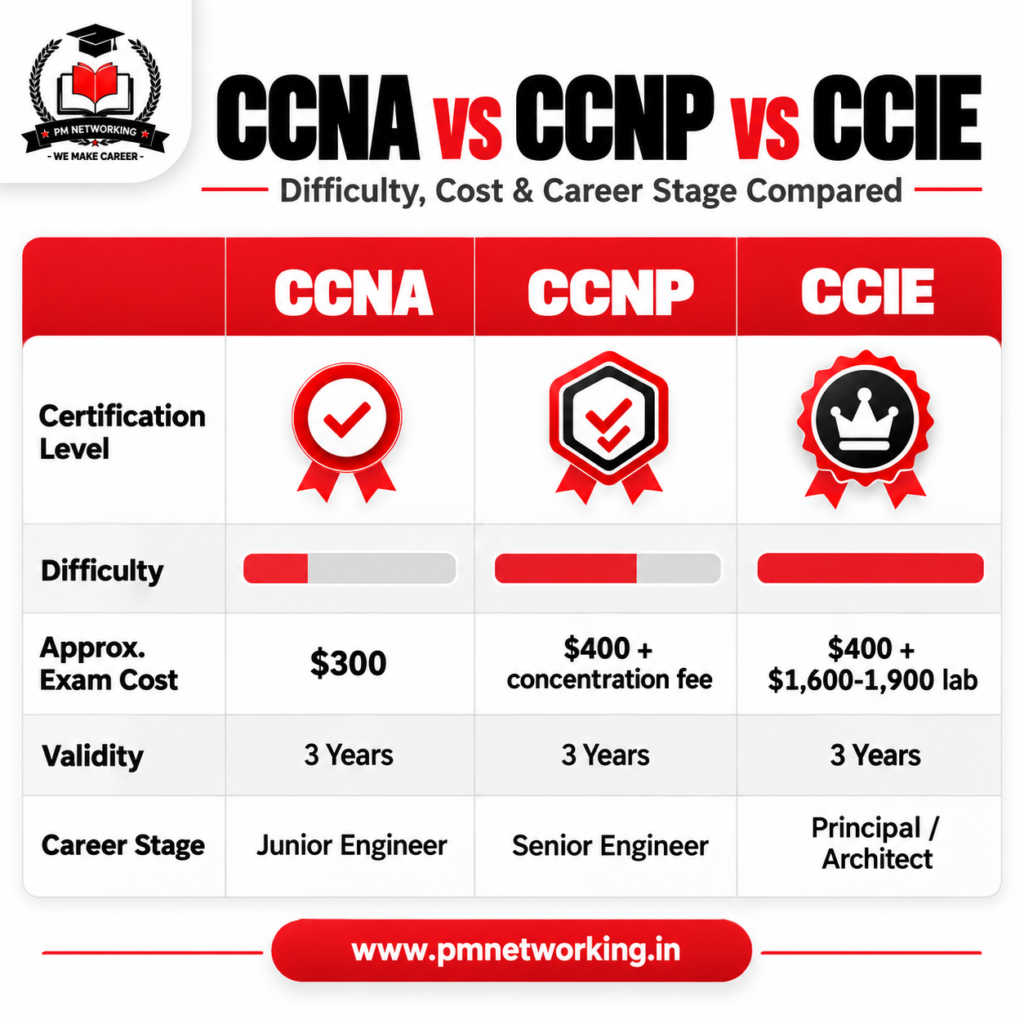
CCNA vs CCNP vs CCIE: Side-by-Side Comparison
| Point | CCNA | CCNP | CCIE |
|---|---|---|---|
| Prerequisite | None | None formally, but CCNA-level knowledge expected | CCNP-level knowledge expected |
| Exam structure | One exam | Core exam + concentration exam | Written exam + 8-hour lab exam |
| Approximate exam cost | $300 USD | $400 core + separate concentration fee | $400 core + $1,600-$1,900 for the lab |
| Validity | 3 years | 3 years | 3 years |
| Difficulty | Moderate, broad coverage | High, focused depth | Extreme, hands-on under time pressure |
| Typical career stage | Junior Network Engineer | Senior Network Engineer | Principal Engineer, Architect |
How Long Does the Full Path Take?
Realistically, going from zero networking background to CCIE takes 3-5 years, assuming steady study alongside real work experience. It isn’t a path you rush — Cisco intentionally expects hands-on job experience between levels, which is why CCIE has no fixed prerequisite exam gap, just an expectation of genuine depth.
A rough timeline looks like this:
- Year 1-2: CCNA, plus a junior networking role to build real-world experience
- Year 3-5: CCNP, usually alongside a senior engineer role where the specialization is actually used daily
- Year 5-7+: CCIE, for those aiming at architect-level or principal engineering roles
Specialization Tracks Beyond Traditional Networking
Cisco’s certification framework has expanded well beyond routing and switching. Depending on where your interests lie, the CCNA → CCNP → CCIE structure now also covers:
- Security track: CCNA → CyberOps Associate → CCNP Security → CCIE Security
- Automation track (formerly DevNet): CCNA → DevNet Associate → CCNP/CCIE Automation
- Data Center, Collaboration, Service Provider, and Wireless tracks follow the same three-tier structure
If you’re drawn to firewalls and security operations specifically, our how to choose the best cybersecurity course blog can help you compare this track against a dedicated cybersecurity certification path.
Do You Need to Go All the Way to CCIE?
Not necessarily. The right stopping point depends on your career goals:
- Want a stable networking career with good pay? CCNP is often enough, and many engineers stay at this level for their entire career.
- Want to lead network architecture decisions or train others? CCIE adds real weight here, since it’s the credential most respected at senior technical levels.
- Not sure yet? Start with CCNA. It’s a relatively small time and cost investment, and it gives you real exposure to decide which specialization actually interests you.
Frequently Asked Questions
1. Can I skip CCNA and go directly to CCNP?
There’s no formal prerequisite requiring CCNA first, but CCNP exams assume CCNA-level knowledge. Skipping straight to CCNP without that foundation makes the exams significantly harder than they need to be.
2. How much does the full CCNA to CCIE path cost?
Approximate exam fees alone come to around $300 for CCNA, $400 plus a concentration fee for CCNP, and roughly $2,000-$2,300 for CCIE including the lab exam. Training costs are separate and vary by provider.
3. How long is each Cisco certification valid?
All current Cisco certifications — CCNA, CCNP and CCIE — are valid for 3 years, after which they need to be renewed through continuing education credits or by passing a current exam.
4. Is CCIE worth it if I don’t want to become an architect?
It can still help, since CCIE is widely respected and can open doors to senior technical roles. But given the cost and difficulty, it’s worth pursuing only if your career goals genuinely call for expert-level credibility.
5. Which CCNP track should I choose?
It depends on your interest. Enterprise suits traditional routing and switching careers, Security suits those drawn to firewalls and threat defense, and Automation suits engineers interested in scripting and programmability.
6. Is the Cisco certification path the same for security-focused careers?
The core structure (Associate → Professional → Expert) stays the same, but the actual certifications differ: CyberOps Associate, CCNP Security and CCIE Security replace the traditional Enterprise track exams.
Conclusion
The Cisco certification path isn’t a race — it’s a structured way to build depth over years of real experience, with CCNA as the foundation, CCNP as the specialization, and CCIE as the expert-level peak for those who want to reach it. If you’re starting that journey or planning your next step, explore the CCNA, CCNP Encor + Enarsi, and Cybersecurity courses at PM Networking.

PM Networking is an emerging leader in the ed-tech space, founded by Praphul Mishra in 2020 with a vision to democratize tech education. The journey of PM Networking began as a YouTube channel with the sole purpose of sharing valuable knowledge in the fields of Networking, Cyber Security, and Cloud Computing. What started as a humble effort to educate has rapidly evolved into a comprehensive online learning platform that caters to the growing demand for specialized IT skills. PM Networking stands out in the crowded ed-tech industry by providing affordable, world-class training tailored to the needs of aspiring IT professionals. The platform is dedicated to equipping learners with the skills and knowledge required to excel in the highly competitive tech industry. Whether it’s Networking fundamentals, advanced Cyber Security protocols, or mastering the complexities of Cloud Computing, PM Networking offers a range of courses designed to cater to different levels of expertise.
0 Comments