



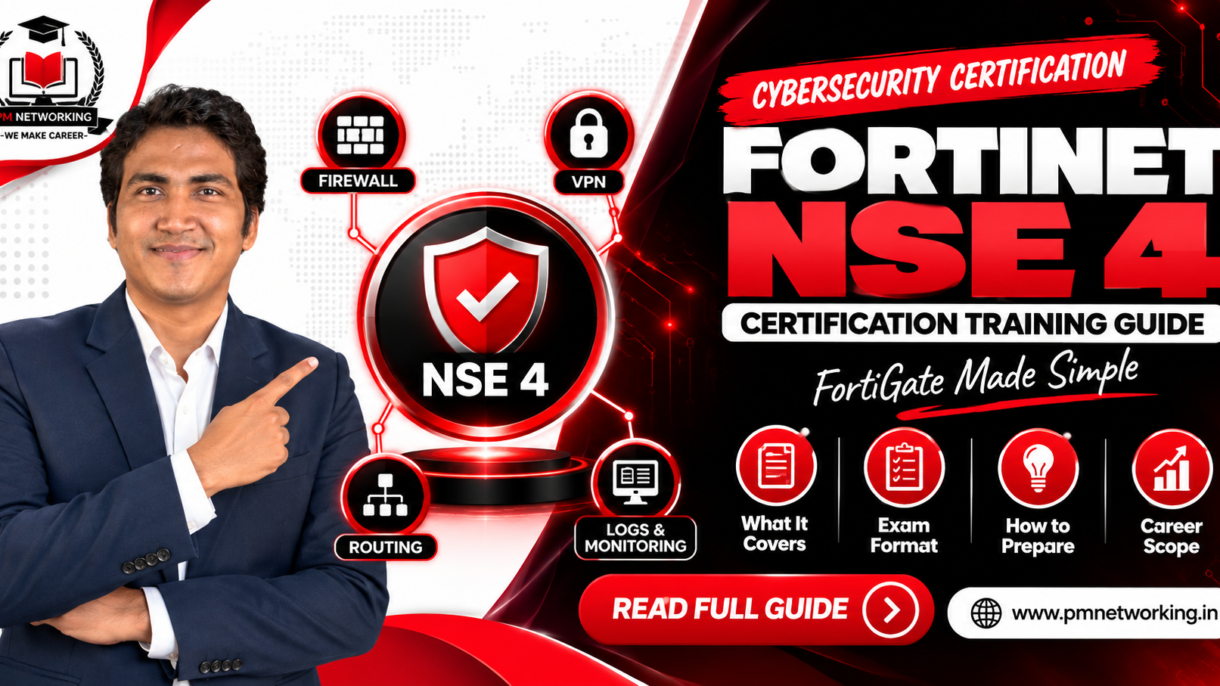
Ask firewall engineers one thing they all agree on, and it’s this: if you work with FortiGate, NSE 4 is the certification employers ask about most. It’s not entry-level, but it’s not deep-architect-level either — it’s the point where employers start trusting you to run a production firewall. This guide covers what NSE 4 is, what it tests, and how to prepare for it.
What Is the Fortinet NSE 4 Certification?
NSE 4 is a level within Fortinet’s Network Security Expert (NSE) certification program, focused on testing your practical ability to configure, manage and monitor a FortiGate firewall. It’s the core exam in the Fortinet Certified Professional (FCP) – Network Security track.
In plain terms: passing NSE 4 means you can deploy a FortiGate firewall, write policies, set up VPNs, and troubleshoot common issues — the everyday work of a firewall administrator.
Where NSE 4 Fits in the Certification Path
| Level | Focus |
|---|---|
| NSE 1-3 | Awareness and sales-level knowledge, non-technical |
| NSE 4 | FortiGate administration — firewall policies, VPN, routing, security profiles |
| NSE 5 | Centralized management (FortiManager, FortiAnalyzer) |
| NSE 6-8 | Advanced architecture, design, and expert-level roles |
Passing NSE 4 is the first major step towards FCP (Fortinet Certified Professional). The full FCP credential typically also requires one NSE 5 elective.
What the NSE 4 Exam Covers
The exam is based on two training courses: FortiGate Security and FortiGate Infrastructure. Together they cover:
- Firewall policies and NAT — traffic control rules, source/destination NAT
- Security profiles — antivirus, web filtering, application control, intrusion prevention (IPS)
- Authentication — local users, LDAP, Fortinet Single Sign-On (FSSO)
- VPN — IPsec and SSL VPN configuration
- Routing — static routing and dynamic protocols such as OSPF
- High Availability (HA) — failover setup to keep the firewall from being a single point of failure
- Logging and monitoring — reading FortiGate logs and identifying issues
If routing basics aren’t solid, the VPN and routing section of the exam will feel much harder than it needs to. Our OSPF vs BGP blog is a good place to firm up routing fundamentals first.
Exam Format and Details
Fortinet updates the exact exam code, fees and format from time to time as FortiOS versions change, so treat the numbers below as a general guide. Always confirm the current exam code, fee and duration on the official Fortinet Training Institute site before you book.
| Point | Typical Range |
|---|---|
| Format | Multiple-choice questions |
| Duration | Roughly 60-105 minutes (varies by version) |
| Passing score | Approximately 70% |
| Validity | 2 years |
| Delivery | Pearson VUE test centers or OnVUE online proctoring |
How to Prepare for NSE 4 Training
- Get FortiGate fundamentals in place. Networking basics — IP addressing, routing, the OSI model — need to be solid before firewall concepts make sense.
- Use the official self-paced courses. Fortinet offers free self-paced “FortiGate Security” and “FortiGate Infrastructure” courses through its training portal.
- Put in hands-on lab time. NSE 4 isn’t a pure theory exam — it tests configuration scenarios. Practice on a real or virtual FortiGate lab is essential.
- Take structured, instructor-led training. Self-study takes longer and leaves doubts unresolved. A guided batch gives you real-world scenarios and supervised labs.
- Run through practice exams. Test your readiness with mock exams before booking the real attempt.
Skills You Should Already Have
There’s no formal prerequisite for NSE 4, but in practice these are expected:
- Basic networking concepts (IP addressing, subnetting, routing) — if these feel shaky, a foundational course like CCNA is worth doing first
- A working understanding of firewall and security concepts
- At least a few months of hands-on FortiGate exposure, whether from a lab or on the job
Why NSE 4 Matters for Your Career
Companies that run FortiGate firewalls — and it’s a widely deployed platform — need engineers who are certified and can handle a production environment. NSE 4 holders are considered for roles such as:
- Network Security Engineer
- Firewall Administrator
- SOC Analyst (firewall-focused)
- Network Support Engineer (security)
The certification also pairs well with Palo Alto or Cisco firewall skills on a resume — multi-vendor firewall knowledge is something employers actively look for.
Frequently Asked Questions
1. What is the Fortinet NSE 4 certification?
It’s a Fortinet certification that tests your practical ability to configure, manage and troubleshoot a FortiGate firewall. It’s the core exam in the Fortinet Certified Professional (FCP) track.
2. What are the prerequisites for NSE 4?
There’s no mandatory prerequisite, but basic networking knowledge and some hands-on FortiGate experience are strongly recommended.
3. How difficult is the NSE 4 exam?
It’s considered an intermediate-level exam. It tests configuration and troubleshooting scenarios rather than pure theory, so hands-on practice matters.
4. How long does the NSE 4 certification stay valid?
Typically 2 years, after which you need to recertify by passing a current exam or a higher NSE level.
5. Is there free training available for NSE 4?
Yes, Fortinet offers free self-paced FortiGate Security and Infrastructure courses on its training portal. Structured, instructor-led training adds practical confidence on top of that.
6. Should I do CCNA before attempting NSE 4?
If networking basics like IP addressing, routing and the OSI model aren’t clear yet, doing CCNA first makes firewall concepts much easier to grasp.
Conclusion
Fortinet NSE 4 proves practical FortiGate administration skills, and it’s in steady demand since FortiGate is such a widely deployed firewall. Hands-on lab practice matters more than theory for this exam. If you want structured guidance and real lab access while preparing for NSE 4, check out the FortiGate Firewall course at PM Networking.

PM Networking is an emerging leader in the ed-tech space, founded by Praphul Mishra in 2020 with a vision to democratize tech education. The journey of PM Networking began as a YouTube channel with the sole purpose of sharing valuable knowledge in the fields of Networking, Cyber Security, and Cloud Computing. What started as a humble effort to educate has rapidly evolved into a comprehensive online learning platform that caters to the growing demand for specialized IT skills. PM Networking stands out in the crowded ed-tech industry by providing affordable, world-class training tailored to the needs of aspiring IT professionals. The platform is dedicated to equipping learners with the skills and knowledge required to excel in the highly competitive tech industry. Whether it’s Networking fundamentals, advanced Cyber Security protocols, or mastering the complexities of Cloud Computing, PM Networking offers a range of courses designed to cater to different levels of expertise.
0 Comments