


Last updated: October 2026
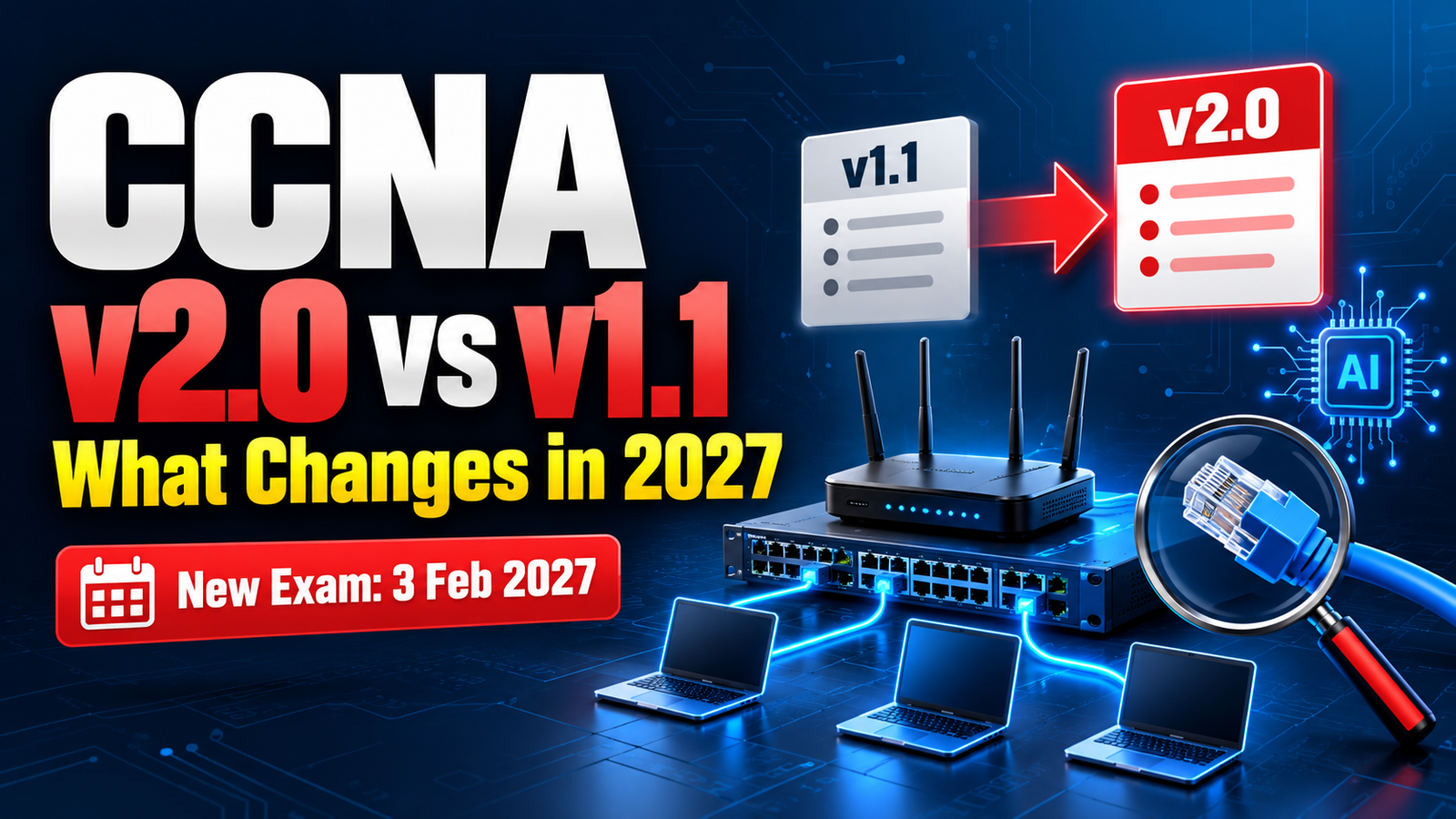
If you’re preparing for CCNA right now, you’ve probably heard the news. Cisco is changing the exam. The new CCNA v2.0 starts on 3 February 2027, and the current CCNA v1.1 will stop on 2 February 2027.
And almost every student we talk to is asking the same thing — “Should I give the exam now, or wait for the new one?”
Let’s clear it up. Below we explain what’s new in CCNA v2.0, what stays the same, how the marks are divided, and which version makes more sense for you.
CCNA v2.0 Quick Facts
- Announced: 20 May 2026 at Cisco Live
- Last date for CCNA v1.1: 2 February 2027
- CCNA v2.0 starts: 3 February 2027
- Exam code: 200-301 (same for both versions)
- Exam duration: 120 minutes (no change)
- Exam fee: USD 300 (no change)
- Certificate: Same CCNA certification, valid for 3 years
One thing to note — both exams won’t run together. After 2 February 2027, v1.1 is simply gone.
What is CCNA v2.0?
CCNA v2.0 is the updated version of the Cisco CCNA exam. Funny part? The exam code is still 200-301. So when you open the booking page, you won’t see any difference. That’s why a lot of people haven’t even noticed the change yet.
But inside, a lot has moved. Cisco has rewritten big parts of the syllabus.
Here’s the main thing you should remember: Cisco wants new network engineers to actually fix problems in a network. Knowing the definition of STP is good. Finding out why a port is blocked is what they want now. On top of that, there’s a brand-new section on AI in networking.
Also Read:- What is CCNA Certification and Why is it Important: Networking Certification
CCNA v1.1 vs CCNA v2.0: Domains and Weights
Right now, CCNA v1.1 has six domains. CCNA v2.0 brings it down to five, with new names and a different marks split.
| CCNA v1.1 Domain | Weight | CCNA v2.0 Domain | Weight |
|---|---|---|---|
| Network Fundamentals | 20% | Network Infrastructure and Connectivity | 25% |
| Network Access | 20% | Switching and Network Access | 25% |
| IP Connectivity | 25% | IP Routing | 20% |
| IP Services | 10% | Network Services and Security | 20% |
| Security Fundamentals | 15% | AI, and Network Operations and Management | 10% |
| Automation and Programmability | 10% | – | – |
So what does this table really tell you?
- Half the exam is now switching and infrastructure. Cables, interfaces, VLANs, STP, wireless clients — give these topics more time than before.
- Routing has a smaller share now — 20% instead of 25%. You’ll still need static routes, OSPFv2, OSPFv3, and you should be able to read HSRP and VRRP status.
- Security hasn’t gone anywhere. It’s just been moved. You’ll find it with NAT, DHCP and other services in one domain.
What Changes in CCNA v2.0?
1. More Troubleshooting Questions
Honestly, this is the change that will matter most on exam day.
In v1.1, a lot of topics said “describe” or “configure”. In v2.0, many of those same topics now say “troubleshoot” or “diagnose”. Different word, very different level of difficulty.
Some examples of what you’ll be expected to handle:
- Spot interface and cable issues — duplex mismatch, speed mismatch, errors
- Fix IPv4 and IPv6 addressing problems
- Solve connectivity issues on wired and wireless clients
- Troubleshoot DHCPv4 clients, servers and relays
You can’t learn this from PDFs alone. You have to sit in front of a lab, break things and fix them.
2. New AI Domain
There’s a new 10% domain called “AI, and Network Operations and Management”. It covers:
- The role of agentic AI in network operations
- Picking the right prompt for a generative AI tool to help with networking work
- Network management basics like SNMP, syslog and Ansible
Relax, nobody is asking you to build an AI model. You just need to know how AI tools help network engineers, and whether their suggestion makes sense or not.
3. Security Becomes More Practical
ACLs, port security, DHCP snooping, dynamic ARP inspection, AAA (TACACS+ and RADIUS), IPsec VPN basics — all of these are still in the exam. What’s different is the question style. Less “what is this”, more “set it up and check if it’s working”.
Read more:- What is Dynamic ARP Inspection and Why it is Important for Network Security
4. Less Heavy Automation Theory
Good news for students who found REST API and JSON boring — there’s less of it in v2.0. Automation now sits inside the AI and network operations domain.
What Stays the Same in CCNA v2.0?
The foundation is exactly the same. Whether you sit v1.1 or v2.0, you’ll need these:
- Subnetting and IP addressing
- VLANs, trunking and STP (Rapid PVST+)
- EtherChannel
- OSPF
- ACLs and NAT
- DHCP and DNS
- Wireless basics
- IPv6
So if you’ve already started studying, don’t stress. Every hour you’ve put in still counts.
Read more:- What is DNS and DHCP in Networking
Should You Take CCNA v1.1 or Wait for CCNA v2.0?
Take CCNA v1.1 if:
- You’re already studying and can be ready before 2 February 2027
- You need the certificate soon — for a job switch, an interview or a promotion
- Your books and practice tests are made for v1.1
Wait for CCNA v2.0 if:
- You’re starting CCNA from scratch today
- There’s no way you’ll be ready before February 2027
- You’d like to learn the new troubleshooting and AI topics from day one
One thing many students don’t know: your certificate doesn’t mention v1.1 or v2.0. It’s the same CCNA, valid for 3 years either way. So if you can be ready before the deadline, waiting gives you nothing extra.
CCNA v2.0 Exam Fee in India
No change here. The fee is still USD 300 plus GST. In rupees, that’s somewhere around ₹26,000 to ₹32,000 — it depends on the dollar rate on the day you book. Your training fee is separate from this.
Want the full picture of the cost? Read our guide on CCNA Course Fees and Certification Cost in India.
How to Prepare for CCNA in 2026–2027
Here’s what we tell our own students:
- Get your basics strong first. Subnetting, IP addressing, OSI and TCP/IP. If these are weak, everything else feels hard.
- Practise labs every single day. Packet Tracer is free. Build a small network, break something on purpose, then find the problem. That’s literally what v2.0 will test.
- Spend extra time on switching. It’s 50% of the new exam.
- Get comfortable with show commands. show ip interface brief, show interfaces, show vlan, show ip route, show ip ospf neighbor — you’ll use these all the time.
- Learn a little about AI. Just enough to understand how AI network assistants work and how to write a clear prompt.
- Check the official exam topics before you book. Cisco keeps the latest list on its CCNA exam page.
Want someone to guide you through all this with live classes and real labs? Have a look at our CCNA Course Online. If you like studying at your own speed, the CCNA 200-301 Recorded Course might suit you better.
Frequently Asked Questions
What is CCNA v2.0?
It’s Cisco’s updated CCNA 200-301 exam, starting 3 February 2027. Compared to v1.1, you’ll see more troubleshooting, more practical security and a new AI section.
When does CCNA v2.0 start?
From 3 February 2027. If you want to give v1.1, your last day is 2 February 2027.
Is the CCNA exam code changing?
No, it stays 200-301. Only the version changes.
Is CCNA v2.0 harder than v1.1?
A bit, yes. The topics are mostly the same, but you’ll be asked to find and fix problems more often. More lab time is the only real answer to that.
Will my CCNA v1.1 certificate become invalid?
Not at all. The exam is changing, your certificate isn’t. It stays valid for 3 years from the day you pass.
What is the CCNA v2.0 exam fee in India?
USD 300 plus GST, same as before. Around ₹26,000 to ₹32,000, depending on the exchange rate.
Should I wait for CCNA v2.0?
Only if you’re just starting and can’t be ready before 2 February 2027. Otherwise, go for v1.1 — you’ll get the exact same certificate.
Final Thoughts
Yes, CCNA v2.0 is a big update. But don’t let it stop your preparation. Subnetting, VLANs, OSPF — none of that is going away. What’s changing is how Cisco checks your skills. They want people who can troubleshoot a real network and who understand where AI fits in.
Our simple advice? If you can be ready before 2 February 2027, book v1.1. If you’re starting fresh, build your basics now and aim for v2.0. In both cases, the formula doesn’t change — strong fundamentals and a lot of lab practice.
Also Read:- Cisco Certification Path: CCNA to CCNP to CCIE
Also Read:- CCNA Certification Salary in India

PM Networking is an emerging leader in the ed-tech space, founded by Praphul Mishra in 2020 with a vision to democratize tech education. The journey of PM Networking began as a YouTube channel with the sole purpose of sharing valuable knowledge in the fields of Networking, Cyber Security, and Cloud Computing. What started as a humble effort to educate has rapidly evolved into a comprehensive online learning platform that caters to the growing demand for specialized IT skills. PM Networking stands out in the crowded ed-tech industry by providing affordable, world-class training tailored to the needs of aspiring IT professionals. The platform is dedicated to equipping learners with the skills and knowledge required to excel in the highly competitive tech industry. Whether it’s Networking fundamentals, advanced Cyber Security protocols, or mastering the complexities of Cloud Computing, PM Networking offers a range of courses designed to cater to different levels of expertise.
0 Comments