






When we use the internet, we send and receive data all the time. Whether we are watching a video, sending a message, opening a website, or just playing an online game, data is constantly moving between devices. This data does not travel randomly. It moves through different types of computer networks like LAN, WAN, and MAN, and follows a set of protocols to reach the right place. Two of the most important protocols are TCP and UDP.
TCP stands for Transmission Control Protocol, and UDP stands for User Datagram Protocol. Both are used to send data over the internet, but they work in different ways. Understanding the difference between TCP and UDP is simple if we look at how they deliver data and why they are used.
What Is TCP?
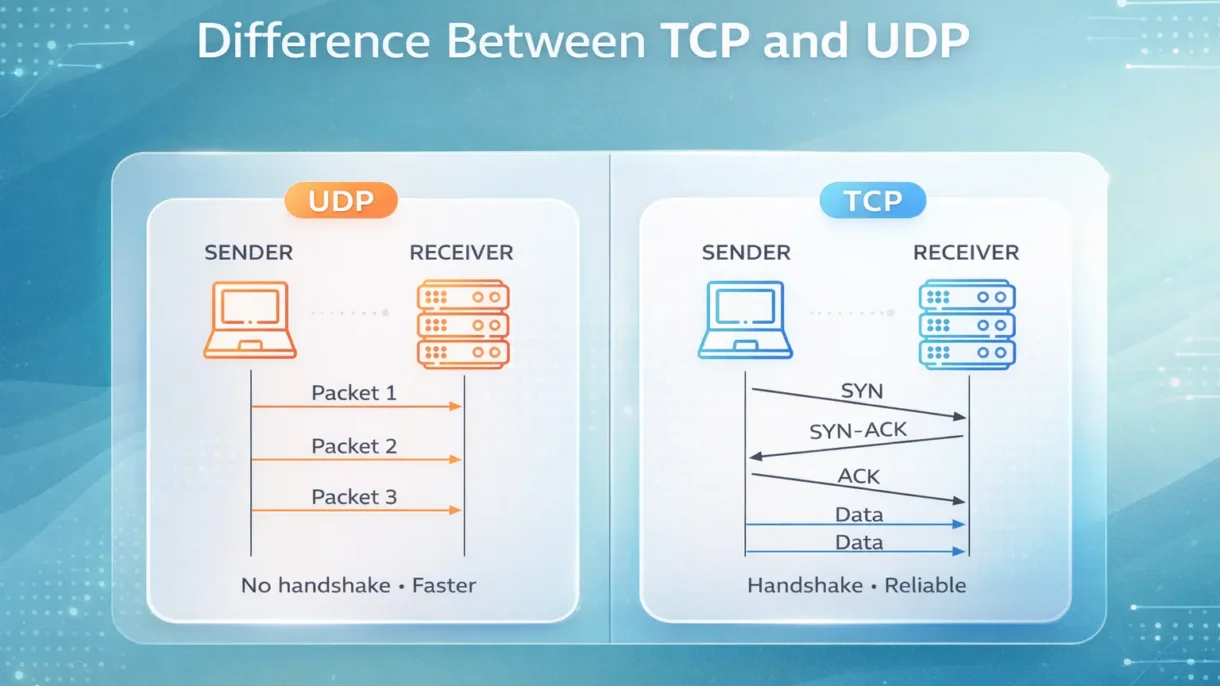
TCP is a protocol that focuses on reliability. This means it makes sure the data reaches its destination safely and in the correct order. Before sending any data, TCP first creates a connection between the sender as well as the receiver. This process is often compared to making a phone call. You connect first and then you start talking.
Transmission Control Protocol checks if the data has been transmitted correctly, and if any data is lost, TCP sends it again. Because of this, Transmission Control Protocol is considered reliable; it guarantees that all the data is received in the correct order and that no data has been lost.
For example, when opening a webpage, your web browser uses TCP. This is because websites need to load correctly therefore, if even a small part of the webpage is missing, the page may not display properly. TCP makes sure that everything is received properly so that a webpage can work as intended.
However, because TCP checks everything and resends lost data, it can be slower. It takes extra time to confirm delivery and fix errors. So although TCP is very accurate, it may not always be the fastest option.
What Is UDP?
UDP is different because it focuses on speed rather than reliability. It sends data without first creating a connection. There is no checking to confirm if the data arrived safely. It simply sends the data and moves on.
UDP does not resend lost data. It also does not check whether the data arrived in the correct order. Because of this, UDP is much faster than TCP. There is less delay since it skips many of the safety checks.
UDP is commonly used for live streaming, online games, and video calling applications because in these situations, speed matters more than quality. For example, during a live video call, it is better to miss a small piece of sound than to wait for it to be resent. The reason that UDP is used in these types of programs is because of how fast it is able to transmit data.
Main Difference Between TCP and UDP
The main difference between TCP and UDP is reliability versus speed. TCP makes sure everything arrives correctly, but it may be slower. UDP sends data quickly, but it does not guarantee delivery.
TCP creates a connection before sending data, whereas UDP does not. TCP checks for errors and resends missing data, but UDP does not do that. Therefore, TCP is careful and accurate, while UDP is fast and lightweight.
The way TCP and UDP handle data order is another difference. TCP makes sure the data arrives in the same order it was sent, which is especially important when you are downloading files or loading web pages. UDP does not care about order. It just sends packets independently. Although this may sound risky, it works well for activities where speed matters more than perfect order.
When Is TCP Used?
TCP is used in situations where accuracy is very important. For example, when you send an email, download a file, or access a secure website, TCP is used. This is because losing even a small amount of data could cause problems.
Online banking also uses TCP. This is because financial transactions must be correct and complete. Even a tiny mistake could create serious issues. TCP ensures that every piece of information arrives safely, and hence it is trusted for sensitive tasks.
File transfers also depend on TCP. If you are downloading software or documents, you need every part of the file. If something is missing, the file may not open properly. TCP checks and resends data when needed, thereby making sure the final file is complete.
When Is UDP Used?
UDP is used when speed is more important than perfect accuracy. For example, in online gaming, quick responses are necessary. If there is a small delay, the game may feel slow. Since UDP does not wait for confirmation, it keeps the game running smoothly.
Live video streaming also uses UDP. Although some data may be lost, the viewer may not even notice. It is better to continue the video smoothly rather than pause and fix small errors.
Voice calls over the internet also use UDP. In conversations, a slight missing sound is not a big problem. But a delay would make the conversation awkward. So UDP is chosen because it reduces delay and keeps communication natural.
Why Both TCP and UDP Are Important
You might wonder why we need both TCP and UDP. The reason is simple. Different tasks have different needs.
Some tasks need accuracy and safety, such as banking and file downloads. In these cases, TCP is the better choice. Other tasks need speed and smooth performance, such as gaming and streaming. In these cases, UDP works better.
Although they work differently, both TCP and UDP are essential for the internet. They help different types of applications function properly. Without TCP, many services would not be reliable. Without UDP, many real-time services would feel slow and unresponsive. If you ever face loading issues due to DNS problems, you can also try to clear DNS cache in Chrome to refresh network lookups.
Simple Comparison
To make it even clearer, consider what would happen when sending out a package. TCP is similar to using a courier service which requires a signature. You know the package arrived safely. However, because of all of the checks that the courier performs, this method may take longer.
UDP is like throwing a ball to a friend. but has a possibility of either missing or being damaged in transit. Though it is less secure, it is much faster and works well when small mistakes do not matter much.
Final Thoughts
TCP (Transmission Control Protocol) and UDP (User Datagram Protocol) are methods used to transmit data over the Internet. TCP ensures reliability and performs checks on everything. UDP does not perform as many checks, making it fast and simple.
Each has its own purpose and is extremely important. TCP is used when accuracy matters most, whereas UDP is used when speed is more important. Understanding the differences between TCP and UDP assists us in understanding how the internet operates smoothly on a daily basis, even though there is an enormous amount of data being transferred around the world.

PM Networking is an emerging leader in the ed-tech space, founded by Praphul Mishra in 2020 with a vision to democratize tech education. The journey of PM Networking began as a YouTube channel with the sole purpose of sharing valuable knowledge in the fields of Networking, Cyber Security, and Cloud Computing. What started as a humble effort to educate has rapidly evolved into a comprehensive online learning platform that caters to the growing demand for specialized IT skills. PM Networking stands out in the crowded ed-tech industry by providing affordable, world-class training tailored to the needs of aspiring IT professionals. The platform is dedicated to equipping learners with the skills and knowledge required to excel in the highly competitive tech industry. Whether it’s Networking fundamentals, advanced Cyber Security protocols, or mastering the complexities of Cloud Computing, PM Networking offers a range of courses designed to cater to different levels of expertise.
0 Comments