


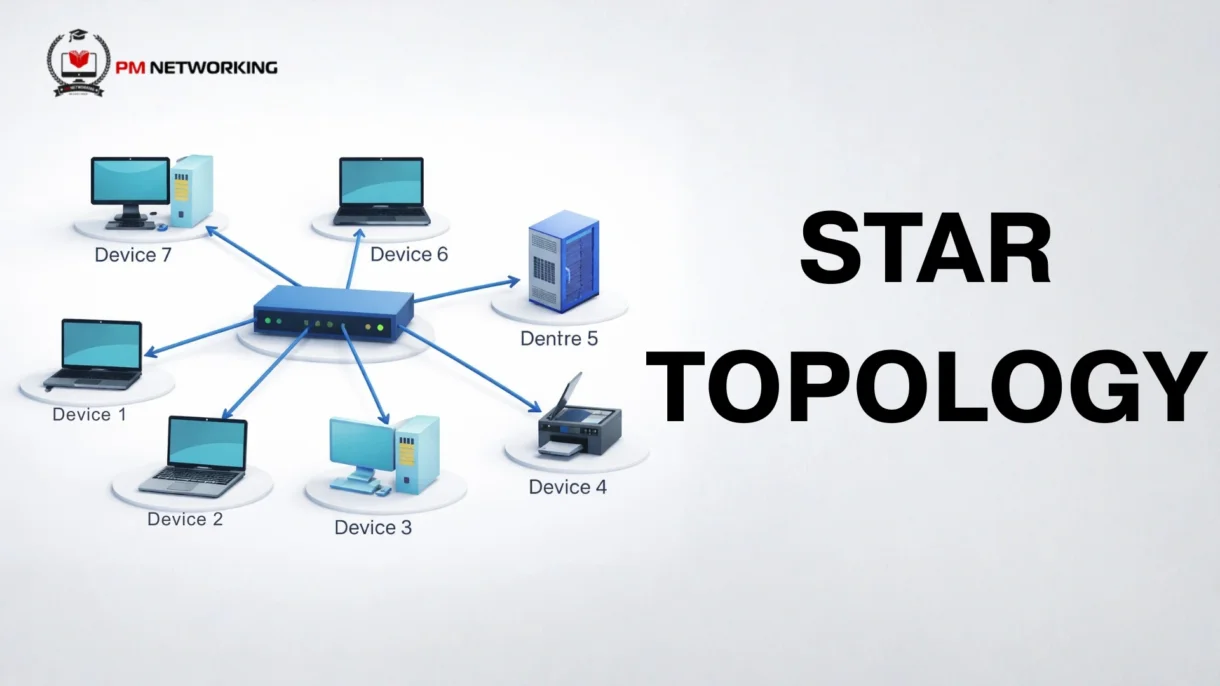
Star topology refers to a type of network setup where each device connects directly to a central device like a hub or switch. It is a popular computer network setup since it can be easily controlled and easily troubleshooted. Star topology is reliable and scalable as failure of one device does not affect the rest of the network.
What Is Star Topology in Computer Networks?
In simple terms, star topology in computer networks means that all devices (like computers or printers) are connected to a central device, such as a hub or switch. The central device acts as a middleman that transmits information between the devices. This makes it easy to control and monitor the network since everything flows through one central point. When something is wrong with one device, the rest of the network is not affected, and this increases reliability within the system.
Star Topology Explained with Example
A simple star topology example would be an office or school LAN (Local Area Network). In this setup, all computers or devices are linked to a central switch. The switch is the central point that controls communication among all the devices.
As an example, consider an office with all of its employees all having computers connected to a central switch. A failure in one computer will not impact other computers since they’re all independently connected to the switch. It is therefore easy to troubleshoot without disrupting the whole network. This is the advantage of star network topology- everything is linked through a central point.
Key Characteristics of Star Topology
Star topology has a number of advantages that have made it popular in most networks. Centralized control is one of the key features of star topology as one device (such as a switch) controls all connections, and it is less complicated to manage the network. Easy fault isolation is another characteristic; if one device fails, it doesn’t affect the rest of the network, so troubleshooting becomes straightforward. Lastly, independent node connections mean that each device is directly linked to the central hub, reducing the risk of issues spreading.
Types of Star Topology
Passive Star Topology
In passive star topology, the central device (usually a hub) is simply a connector that does not actively control the flow of data. It just forwards the data signals to the devices.
It is also cost-effective and easy to use as it utilizes basic devices like hubs. The drawbacks, however, include lower performance and reliability since hubs don’t manage data, and the network may slow down as more devices are added.
Active Star Topology
Active star topology uses a switch or router as the central device which makes it more efficient. Switches are also better at managing data flow between devices, unlike hubs and therefore improve network performance and speed.
This kind of topology is performance-oriented, the switch makes sure the data is transmitted to the proper device so that it does not get stuck in one place, hence making the network faster and more reliable.
Extended Star Topology
In extended star topology, multiple switches are used to create larger networks, often in large LANs (Local Area Networks). This setup connects smaller star networks to form a larger, more complex network.
It is highly scalable, such that adding more switches can expand the network without major issues. However, it requires more careful management due to the increased number of devices, making it more complex than a simple star setup.
How Data Travels in a Star Topology
In a star topology, when data is sent from one device, it goes to the central device (usually a switch), which then forwards it to the destination device. The process works like this:
- The sender sends data to the central switch.
- The switch looks up the destination device and sends the data to it.
- If the destination device isn’t available, the data doesn’t get lost, but the communication fails.
Because of the centralized control, loops don’t happen in a star topology. The central device ensures data flows in a controlled manner, preventing any data from bouncing around endlessly like in other topologies, such as mesh or ring networks.
Components of a Star Network
The components of star topology include the central device (usually a switch or hub), which manages all the connections. Nodes are the networking devices connected to this central hub like computers, printers, or servers. Network cables link each node to the central device that ensures data flows smoothly between them.
Advantages and Disadvantages of Star Topology
The advantages of star topology include easy management and fault isolation, as problems with one device don’t affect others. It’s also scalable, meaning you can add more devices without disrupting the network. On the downside, one of the disadvantages of star topology is that if the central device (like a hub or switch) fails, the entire network goes down. It can also be more expensive due to the need for a central device and more cables.
Star Topology vs Other Network Topologies
Star vs Bus Topology
In a bus topology, all devices are connected to a single shared cable, while in star topology, each device connects to a central device. Bus networks are less expensive but are also less dependable; failure of the shared cable will impact on the entire network. Star topology is more reliable as all the devices are directly connected to the central one, and it is easier to isolate the problem.
Star vs Ring Topology
In a ring topology, each device is connected in a circle, with data traveling around the ring. The failure of a single device or connection can break the whole network. Conversely, star topology isolates issues to a single device, keeping the rest of the network running smoothly. Ring networks may not perform as well with more devices, while star networks offer better performance as well as scalability.
Real-World Uses of Star Topology
Offices & Enterprises: Star topology is widely used in office networks since it is easy to maintain and troubleshoot, and easy to fix in case of a failure.
Home & Smart Devices: Many home networks, particularly smart device ones such as thermostats or security cameras, use star topology. Each device connects to a central router/hub.
Universities & Labs: Universities tend to employ star topology in campus systems because it can support large numbers of devices and is easy to scale for growing networks.
Banks & Data Centers: Star topology is very easy to manage and has high availability. This is suitable when it comes to sensitive environments like banks and data centers, where reliability is of utmost importance.
Hospitals & Healthcare: Star topology is used in hospitals, where many devices need constant communication; it provides the reliability needed to manage devices like patient monitors and medical equipment.
Conclusion
Star topology is the most practical and widely used network design. It offers centralized control, easy troubleshooting, and strong reliability. If one device fails, it typically won’t disrupt the others. It scales well for growing networks and is common in real-life setups like offices, homes, universities, banks, hospitals, and data centers. However, the central hub/switch is the main weakness: if that core device fails, the entire network can go down. The design can cost more due to extra cabling and required central hardware.
FAQ
1. What is Star Topology in simple terms?
Star topology is a network setup where all devices are connected to a central hub/switch. This makes it easy to manage as well as troubleshoot.
2. What are the main advantages of Star Topology?
It’s easy to add devices, isolate faults, and manage the network. However, if the central hub fails, the whole network can go down.
3. How does data travel in Star Topology?
Data travels from the source device to the central hub, which then forwards it to the destination device. This keeps the network organized.
4. What’s the difference between Star and Bus Topology?
In bus topology, all devices share a single cable. In star topology, each device connects directly to a central hub which makes it more reliable.
5. Where is Star Topology commonly used?
Star topology is widely used in offices, universities, homes with smart devices, and even in hospitals for easy management and reliability.

PM Networking is an emerging leader in the ed-tech space, founded by Praphul Mishra in 2020 with a vision to democratize tech education. The journey of PM Networking began as a YouTube channel with the sole purpose of sharing valuable knowledge in the fields of Networking, Cyber Security, and Cloud Computing. What started as a humble effort to educate has rapidly evolved into a comprehensive online learning platform that caters to the growing demand for specialized IT skills. PM Networking stands out in the crowded ed-tech industry by providing affordable, world-class training tailored to the needs of aspiring IT professionals. The platform is dedicated to equipping learners with the skills and knowledge required to excel in the highly competitive tech industry. Whether it’s Networking fundamentals, advanced Cyber Security protocols, or mastering the complexities of Cloud Computing, PM Networking offers a range of courses designed to cater to different levels of expertise.
0 Comments