






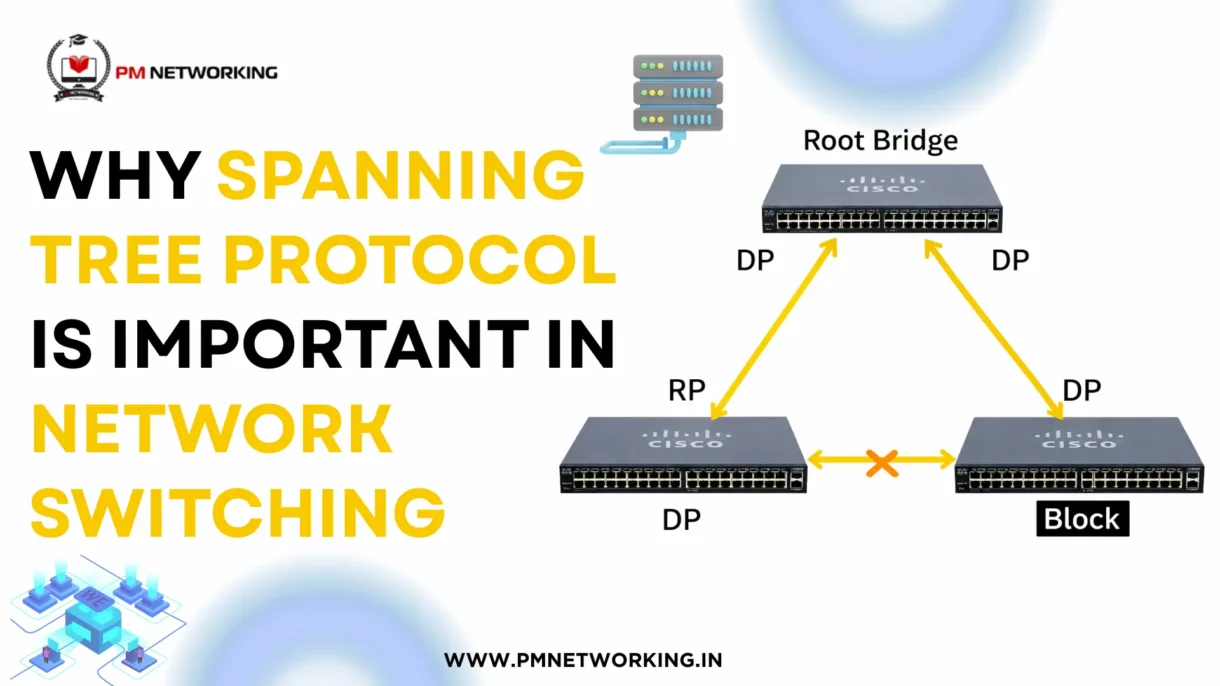
In a switched network, network loops happen when more than one active path exists between switches. While having multiple paths may seem useful, this results in serious problems because switches keep sending the same traffic over and over. Since switches don’t know when to stop, loops can quickly flood the network.
This is where Spanning Tree Protocol becomes important. Spanning Tree Protocol prevents network loops and ensures reliable switching by allowing only one active path and blocking the rest. Though backup links are still available, only one path is used at a time, thereby keeping the network stable.
Without Spanning Tree Protocol in networking, network loops can bring down an entire switch network in seconds. Because of this, Spanning Tree Protocol Cisco uses is a critical feature in modern switching networks.
What is Spanning Tree Protocol?
Spanning Tree Protocol (STP) is a protocol used in switches to stop network loops. It ensures only one active path exists between switches, although multiple links may be connected.
The purpose of spanning tree protocol in networking is to keep networks stable. Extra links are useful, but they can cause loops, thus STP controls them to avoid network failures.
STP works by selecting a root bridge. It then blocks redundant paths, while keeping them available as backups. Because of this, spanning tree protocol Cisco uses helps maintain reliable switching.
Without Spanning Tree Protocol in networking, network loops can bring down an entire switch network in seconds. Because of this, Spanning Tree Protocol Cisco uses is a critical feature in modern switching networks. Spanning Tree Protocol is a core topic covered in the CCNA networking course, making it essential knowledge for anyone learning network switching.
How Spanning Tree Protocol Works in Networking
Spanning Tree Protocol in networking ensures loop-free topology by managing how switches communicate with one another, and instead of allowing all paths to stay active, STP checks the network and decides which paths should be used and which should wait.
First, STP selects one switch as the root bridge. This switch becomes the main reference point for the entire network. All other switches calculate the best path to reach this root.
Next, STP assigns port roles. A root port is the best path toward the root bridge. A designated port forwards traffic for a network segment. A blocked port is shut down to prevent loops, although it stays ready as a backup.
Switches share this information using BPDU (Bridge Protocol Data Units). These messages help switches compare paths and make decisions. Because of this constant exchange, the network stays stable and loop-free.
Importance of Spanning Tree Protocol in Network Switching
One of the biggest benefits of Spanning Tree Protocol is that it prevents network loops. Since loops can cause broadcast storms and crash switches, STP blocks extra paths and keeps traffic under control.
STP also allows redundancy without problems. Although multiple links exist for backup, only one path is active at a time. Thus, the network stays protected while still having alternate routes ready.
In enterprise networks, STP helps ensure high availability. If an active link fails, STP quickly enables a backup path. Because of this, users experience less downtime and smoother connectivity.
For example, in office networks and data centers, switches are often connected in many ways. Spanning Tree Protocol Cisco switches use helps these environments stay stable, even when the network design is complex.
Common Issues and Troubleshooting
Sometimes Spanning Tree Protocol can cause network slowdowns if it is misconfigured. For example, the wrong switch may become the root bridge, which then leads to longer paths as well as poor performance. Although the network still works, traffic flows may not be as efficient as they should be because of inefficiently long paths.
On Cisco switches, features like BPDU Guard and Root Guard help protect the network. BPDU Guard shuts down ports if unexpected BPDUs are received, while Root Guard prevents unauthorized switches from becoming the root bridge. Because of this, the network stays more secure and predictable.
When troubleshooting STP loops, always check which switch is the root bridge. Then look for blocked or constantly changing ports. Using STP status commands helps identify where the loop or misconfiguration exists.
Conclusion
Spanning Tree Protocol is critical for network reliability because it prevents loops, controls traffic, and keeps switch networks stable. Without it, even small switching networks can fail quickly.
For anyone pursuing a networking certification, as well as working in enterprise environments, it is important to have a good understanding of Spanning Tree Protocol (STP). As most modern networks depend heavily on switches, all networking professionals must develop this critical skill set.
FAQ
1. What problems can occur if STP is not configured correctly?
Misconfigured STP can cause loops, broadcast storms, or slow networks. In some cases, it can even bring down the entire switching environment.
2. What is the purpose of Spanning Tree Protocol in networking?
The purpose of spanning tree protocol in networking is to prevent network loops between switches. It ensures stable and reliable data forwarding.
3. How does STP prevent network loops?
STP blocks extra paths between switches and allows only one active path. Thus, traffic does not loop endlessly in the network.
4. What is the difference between STP, RSTP, and MSTP?
STP is slower, while RSTP converges faster after failures. MSTP supports multiple spanning tree instances for better performance.
5. How is Spanning Tree Protocol configured on Cisco switches?
On Spanning Tree Protocol Cisco switches, STP is usually enabled by default. Network admins configure root bridge priority and protection features like BPDU Guard.

PM Networking is an emerging leader in the ed-tech space, founded by Praphul Mishra in 2020 with a vision to democratize tech education. The journey of PM Networking began as a YouTube channel with the sole purpose of sharing valuable knowledge in the fields of Networking, Cyber Security, and Cloud Computing. What started as a humble effort to educate has rapidly evolved into a comprehensive online learning platform that caters to the growing demand for specialized IT skills. PM Networking stands out in the crowded ed-tech industry by providing affordable, world-class training tailored to the needs of aspiring IT professionals. The platform is dedicated to equipping learners with the skills and knowledge required to excel in the highly competitive tech industry. Whether it’s Networking fundamentals, advanced Cyber Security protocols, or mastering the complexities of Cloud Computing, PM Networking offers a range of courses designed to cater to different levels of expertise.
0 Comments